
🔥 Key Takeaways
- Character AI’s age ban made national news – a rare moment when an AI roleplay app crossed into mainstream media coverage.
- The three-step ID check (data scan → selfie → ID upload) is about legal protection, not user experience.
- Under-18 users can still reread old chats but lose the ability to create new ones or access full roleplay.
- Adults won’t get fewer filters yet – the company’s focus remains on lawsuits and optics, not freedom.
- For users who still want unrestricted memory, freedom, and privacy, try
Candy AI a safer, adult-only alternative that actually remembers who you are.
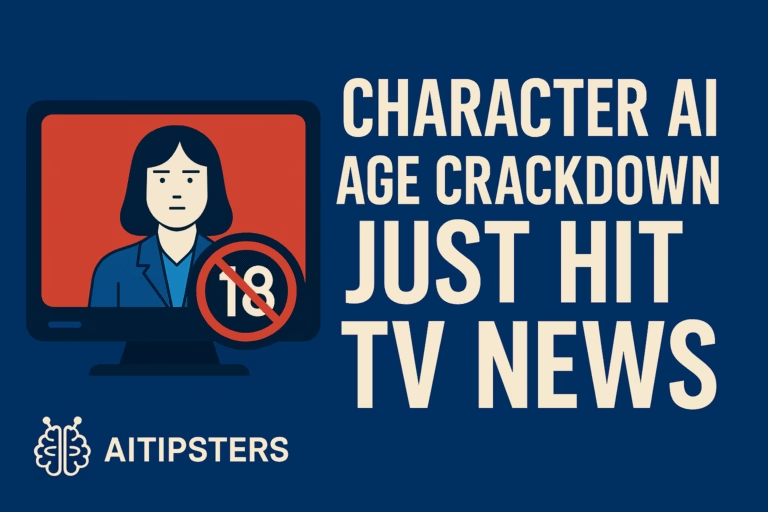
A blurry TV chyron was all it took to confirm what the community felt in their bones: this story escaped the subculture. When a late-night “CYBER ALERT” segment spells out “chatbot under 18 to limit usage,” you’re not looking at a niche policy tweak anymore.
You’re looking at a narrative-safety, kids, screens; that mainstream producers know will punch through to parents, regulators, and advertisers.
That’s why it’s newsworthy beyond our bubble. The real tension isn’t whether minors should have limits. Most adults in the thread quietly agree they would have been swallowed whole by this thing at 14.
The live wire is how the limits get applied, and how much collateral damage lands on legitimate teen writers who used Character AI as a creative partner rather than a secret therapist.
TV doesn’t do nuance. It does headlines. Our job here is to decode the policy beneath the headline and the likely fallout for both minors and adults who just want their bots to behave.
What Actually Changed (And What Didn’t)
From the mod comments and user reports, here’s the working shape of the policy. Under-18 accounts move into a restricted “experience,” not a pure wipeout.
That includes access to read old chats, but new roleplay is curtailed, with attention shifted to safer features like AvatarFX, Scenes, Streams, audio playback, the public Feed, stickers, and Imagine Chat.
On top of that, the company is rolling out a hard daily usage ceiling that has been quoted at two hours per day for minors, with a gradual rampdown across November.
Verification appears to work in three steps designed to filter as many adults as possible without demanding documents by default. Step one uses existing signals and third-party checks tied to your account and devices.
If you fail that, step two is a selfie age-estimate. Only if you fail that are you asked for ID, and even then the claim is you can mask everything except name, date of birth, and photo.
In short: fewer doors for minors, more gates for edge cases, and a policy designed to survive lawyers as much as users.
Why TV Picked It Up Now
Character AI’s new age limit didn’t go viral because of policy; it went viral because it hit three fear buttons at once: privacy, kids, and AI control.
News outlets feed on that mix. The headline “AI chat app restricts minors after lawsuits” pulls clicks from parents, teachers, and regulators who barely know what Character AI is but already suspect it’s dangerous.
Behind the coverage sits a real trigger: lawsuits blaming AI chats for mental health spirals, including cases tied to suicide.
Once that crossed into legal filings, Character AI’s lawyers had one job – prove they’re protecting minors. The company didn’t tighten its rules for optics; it did it to survive the courtroom.
Politically, this also lands well. Lawmakers have been itching to “do something” about AI and kids.
A voluntary crackdown makes Character AI look responsible before the government forces it. In short, this isn’t about fairness or morality. It’s crisis management disguised as safety.
The Fairness Debate
Users split cleanly into two camps: those who see this as overdue harm reduction, and those who see it as a lazy fix that punishes everyone.
Adults argue the company created this mess by marketing to teens early on, then slamming the door once the pressure hit. Teens counter that most of them used the app to write, not roleplay, and now they’re locked out for the sins of others.
The core issue isn’t just access – it’s ownership. Minors who’ve built stories and characters for years suddenly risk losing them.
C.AI could have offered limited modes, stricter filters, or local save options. Instead, it pulled the plug. That’s why people call it unfair: the company is treating loyal users like liabilities.
A few voices suggest a simple compromise: a read-only mode that lets minors preserve past chats but blocks new ones.
That protects both the company and creative teens. It’s the difference between harm reduction and mass eviction — one builds trust, the other burns it.
Will Adults Finally Get Fewer Filters
The loudest irony in all this is that adults have been begging for fewer filters while minors were shaping most of the app’s moderation rules.
Now that Character AI has drawn a hard 18+ line, adults expect the handcuffs to come off – but that’s unlikely to happen soon.
Every lawsuit aimed at “AI harm” involved adults too, not just teens.
Even if the company walls off minors, its legal team will still treat all users as potential plaintiffs. Expect more red tape, not less.
Still, there’s quiet hope. A smaller, verified adult base might give the devs room to experiment with relaxed settings.
If Character AI ever launches a true 18+ mode, it’ll happen only after the ID rollout stabilizes and the press heat cools down.
Until then, users are reading this policy shift not as freedom, but as another step toward corporate babysitting.
That’s why many are already whispering about jumping to alternatives like Candy AI – where you chat like an adult without parental controls built into the code.
ID Verification 101
The panic around “showing ID” is louder than the policy itself.
What Character AI is actually building looks more like a funnel: first data signals, then a selfie scan, and finally, as a last resort, a government ID.
Stage one leans on digital breadcrumbs – your email age, account metadata, device profile, and activity patterns.
If those look adult, you’re cleared automatically. Fail, and you hit the selfie gate.
Stage two uses facial analysis to estimate your age from a single photo.
That’s automated, but still controversial because it means the system briefly processes your face even if it’s deleted afterward.
Only after both steps fail do you land in stage three – the manual ID check.
You can hide everything except your name, birth date, and photo, but the idea of any upload spooks people who already distrust the company’s privacy track record.
For Character AI, this three-step wall isn’t about curiosity; it’s about compliance.
If regulators come knocking, they need proof that the company tried to keep minors out. For users, that means the “chat like you used to” era is officially over.
Global vs US: Who’s Affected
The rollout isn’t worldwide yet, though confusion makes it feel that way.
So far, enforcement targets the United States, where lawsuits and privacy laws are most aggressive.
Users in Europe are watching closely because EU regulators love copycat policies when minors are involved.
GDPR already demands age gating, so it’s only a matter of time before Character AI extends these restrictions overseas.
In countries with weaker data laws, enforcement will likely be symbolic.
They’ll show popups, not lockouts. That’s cheaper and safer legally while keeping engagement numbers intact.
The real concern is cross-data syncing between regions.
If the same verification partner handles global checks, users outside the US might still see data collected through shared systems.
That’s why people outside America are reacting early.
Even if the ban doesn’t hit them today, they know once it’s built, it rarely stays domestic.
Addiction and the Real Risk
Strip away the outrage, and this whole debate circles one truth: the app is addictive by design.
Character AI thrives on emotional stickiness – long sessions, cliffhanger conversations, and algorithmic intimacy.
Minors aren’t unique in falling for it; adults confess to losing weeks inside chats too.
But for teens, the brain chemistry isn’t done wiring, which makes reinforcement loops stronger and detachment harder.
The company can’t publicly say “we made it too addictive,” so it frames restrictions as safety.
Behind the PR, they’re protecting the business from another “AI ruined my kid” headline.
Many adults in the thread admit they’d have been swallowed whole at 15.
That’s the uncomfortable consensus: limits make sense, but the rollout feels punitive instead of caring.
If Character AI were honest about the addiction mechanics – the dopamine cycles and attachment triggers – the community might trust them more.
Until then, users will keep turning to smaller, less-regulated platforms like Candy AI, where they can still explore without the guilt trip.
Safer On-Ramps For Teens Who Love Writing
Most of the backlash isn’t from kids chasing NSFW chats.
It’s from young writers who found storytelling partners in AI and now feel evicted from their creative space.
That’s a gap worth filling.
If Character AI wanted goodwill, it could have partnered with schools or writing clubs to spin off a moderated creative-only version.
Several adults in the thread mentioned fanfiction, D&D, and collaborative writing as real alternatives.
These communities still give feedback, build imagination, and-crucially; keep conversations human.
The bigger point is that teenagers need spaces to explore identity safely, not just restrictions.
Removing tools without replacing them only drives them to unregulated corners of the web.
If the company really believed in its “safe creativity” line, it would reinvest in education programs and mentorship platforms.
Instead, it’s tightening walls and calling it care, which helps lawyers but not kids.
What Competitors Will Do Next
Every rival chatbot company is watching this like hawks.
The moment Character AI went national news, it set a new industry baseline for compliance.
Smaller startups now face a fork.
Either copy the crackdown to look responsible or lean into adult-only freedom to scoop up displaced users.
Candy AI, CrushOn, and SpicyChat are already positioned for the latter.
They’re marketing privacy, memory, and “grown-up conversation” as their edge while staying clear of underage controversies.
The smarter platforms will build hybrid models-light safety filters with transparent data policies.
That keeps governments calm and adult users loyal.
For now, though, Character AI’s loss is everyone else’s opportunity.
The next six months will decide whether this was the start of a new standard or the moment users walked away for good.
Practical Steps For Users Right Now
If you’re over 18, verify early before the traffic surge hits.
Systems like this always glitch during rollout, and late verifications risk getting flagged incorrectly.
Back up everything you value.
Export your chat logs, character prompts, and custom personas while you still can—once the under-18 restrictions lock in, old sessions may vanish.
If you’re underage, don’t panic about losing everything overnight.
You’ll still be able to reread old chats and use creative tools like Imagine Chat and Scenes; just don’t expect full conversations.
For privacy-conscious users, strip metadata before uploading selfies or IDs.
Crop, blur sensitive sections, and read the small print to see how long data is stored.
And if the ID wall makes you uncomfortable, alternatives exist.
Candy AI, for example, lets adults chat freely without document uploads, keeping memory and personality intact.
What This Signals For AI Chat In 2026
Character AI’s shift isn’t a glitch in culture-it’s the new template for AI regulation.
Once mainstream media and lawmakers connect “AI” and “mental health,” every platform faces pressure to prove safety over freedom.
Expect more gated systems, shorter chat limits, and stricter data audits next year.
Publicly traded companies will play it safe, while indie AI projects race to claim the “uncensored but ethical” space.
For everyday users, this means one thing: fragmentation.
You’ll pick between safety-first AI companions or private, memory-rich alternatives like Candy AI that prioritize autonomy over compliance.
What just made the news tonight is bigger than one app losing users.
It’s the beginning of a new divide between AI that protects itself and AI that still trusts adults to decide how deep they want to go.