What This Really Comes Down To
- Consent is not optional. A real person’s voice or likeness cannot be treated as fandom property.
- Moderation after harm fails. Platforms must block misuse at creation, not apologize later.
- Voices are biometric identity, not creative assets. Treating them otherwise invites abuse.
- Engagement driven shortcuts will cost platforms legally, culturally, and financially.
- If you want fictional intimacy, tools like Candy AI and Nectar AI focus on original characters without hijacking real people’s identities.
This Crossed a Line Fanfiction Never Did
Fanfiction has existed forever.
Self inserts. Alternate universes. Questionable ships. Even real person fiction, messy as it is.
But this situation is different, and pretending it isn’t is intellectual dishonesty.
What happened here was not imagination.
It was extraction.
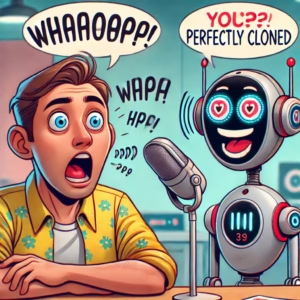
A real person’s voice was ripped from existing recordings, processed, and re deployed so an AI could speak as them without consent. Not a character they played. Not a fictional role. Their actual voice, the thing they earn a living with, the thing that identifies them.
That is not fandom.
That is not creativity.
That is not play.
That is impersonation at scale.
The reason the backlash exploded is simple. People intuitively understand that a voice is not a costume. You can take off cosplay. You cannot take off your voice. When an AI speaks using it, the speaker loses control over what they “say” forever.
That is why comparisons to Wattpad miss the point completely.
A fanfic doesn’t put words in your mouth that sound exactly like you said them.
A chatbot does.
And once that boundary breaks, everything else follows.
Consent Is Not Optional Just Because the Tech Exists
Here’s the uncomfortable truth a lot of AI discourse avoids.
Technical possibility does not equal moral permission.
Yes, it is easy to scrape audio.
Yes, a few seconds is enough.
Yes, platforms make it frictionless.
None of that matters.
The actor explicitly said they were not okay with it.
That should have ended the conversation immediately.
Instead, the pushback revealed something darker. A subset of users genuinely believe that if they personally wouldn’t mind having their identity cloned, then no one else should either.
That logic collapses instantly under scrutiny.
Consent is individual.
It is contextual.
It is revocable.
And most importantly, it belongs to the person whose body, voice, or likeness is being used.
This is why voice actors reacted so strongly. Their voice is not a fan bonus. It is their labor. Their reputation. Their safety. An AI can be made to say anything. Slurs. Threats. Sexual content. False confessions. None of which can be easily disproven once audio exists.
That is not theoretical harm.
That is reputational and personal risk.
And when platforms allow this to continue after explicit objections, they are not neutral intermediaries. They are participants.
Why Platforms Look the Other Way
This is the part most people dance around because it makes everyone uncomfortable.
Platforms do not allow celebrity or voice based bots by accident.
They allow them because they drive engagement.
Real people create stickier interactions than fictional ones. Users stay longer. They return more often. They form habits faster. That translates directly into retention metrics, subscription upgrades, and ad impressions. When a bot feels like a real person, users treat it like one. That emotional hook is worth money.
Which means enforcement becomes selective.
Rules exist. Reporting forms exist. Apologies get posted. But removal is slow, inconsistent, and often incomplete. Bots get taken down while voice presets remain. Presets get re uploaded under slightly different names. Moderation turns into whack a mole.
This is not a technical failure. It is a business compromise.
The moment platforms aggressively removed all real person likenesses without consent, a large portion of their most engaged users would disappear overnight. That is the trade they are making, whether they admit it publicly or not.
And that is why responsibility keeps getting pushed back onto users.
Report it. Flag it. Email someone. Wait.
Meanwhile, the system that made it possible stays intact.
This is also why arguments about Creative Commons or licensing get muddy. Even when content is share alike, voices are not. Human likeness is not. Yet platforms hide behind ambiguity because ambiguity buys time.
Time means revenue.
This Is About Power, Not Technology
Strip away the fandom arguments and what you are left with is a power imbalance.
One side has resources, lawyers, infrastructure, and plausible deniability.
The other side has a voice and a public statement asking people to stop.
That asymmetry matters.
When someone says, if it were me I would not mind, they are speaking from a position of not being vulnerable. They are not the one whose livelihood depends on vocal identity. They are not the one whose reputation can be damaged by a single generated clip taken out of context.
The uncomfortable reality is that AI makes exploitation scalable. It removes friction. What used to require effort now requires none. And when effort disappears, ethical consideration often disappears with it.
That is why this issue keeps escalating across fandoms, not just one. Voice actors today. Artists yesterday. Writers tomorrow. Each time, the same pattern repeats.
Users say it is just fiction.
Platforms say they are just tools.
Creators are left to clean up the fallout.
This is not an anti technology argument. It is a governance argument. Tools without boundaries will always be used to cross them.
And until consent becomes enforceable instead of optional, this problem will keep resurfacing under new names and new platforms.
What Actually Needs to Change (And Why Policing Users Won’t Work)
Right now, platforms pretend this is a user behavior problem.
It is not.
You cannot fix a structural incentive problem with community guidelines and report buttons. As long as likeness based bots increase engagement, they will keep slipping through. As long as voices can be uploaded faster than they can be verified, harm will outpace moderation.
Here is what would actually move the needle.
First, explicit opt in systems for real people.
Not implied consent. Not silence equals approval. A verified permission layer tied to the individual or their representation. No opt in, no likeness. Period.
Second, voice presets must be treated as biometric data, not creative assets.
A voice is closer to a fingerprint than a fan edit. If platforms treated it that way legally and technically, this entire category of abuse would collapse overnight.
Third, enforcement has to be upstream, not reactive.
Taking down bots after harm occurs is too late. Detection has to happen at creation time, not after reports pile up. If platforms can detect copyrighted music uploads instantly, they can detect stolen voices too. They choose not to prioritize it.
And finally, liability has to land somewhere real.
As long as platforms can externalize damage to creators while internalizing profit, nothing changes. History shows this pattern clearly. Regulation only follows when incentives flip.
Until then, asking users to be ethical in an unethical system is just theater.
Why This Will Backfire If It Continues
Here is the part platforms underestimate.
This behavior poisons the well they depend on.
Voice actors become reluctant to record. Writers become guarded. Creators withdraw or watermark their work aggressively. Entire fandoms fracture because trust erodes. And eventually, the quality of source material declines.
AI systems trained on degraded, defensive, or absent creative work get worse, not better.
At the same time, legal pressure compounds. One high profile case is enough to trigger industry wide consequences. Once courts establish precedent around voice ownership and consent, the cleanup will be brutal and retroactive.
Platforms that acted early will survive.
Platforms that optimized for engagement first will scramble.
And users will not be protected in that fallout. Bots disappear. Histories vanish. Communities lose access overnight. The very people who were told it is just fiction will pay the price when the switch flips.
This is why this conversation matters now, not later.
Not because AI is evil.
But because power without restraint always eats its own ecosystem.