
Key Takeaways
Your Character AI chats are not fully private.
Messages live on company servers and can be surfaced for moderation, legal requests, or model training.The product feels private by design but it is optimized for engagement.
The intimate interface encourages oversharing, which increases the risk of sensitive data being captured.Verification failures and timers destroy trust faster than outages do.
Blocking access or requiring buggy face ID turns emotional attachments into active resentment.Ad monetization plus emotional compansion is a risky combination.
Once ads are integrated, the platform shifts from caring for users to optimizing for engagement and revenue.Alternatives are already offering what users want most: privacy, stability, and control.
Local models and privacy-first companions are gaining traction and will accelerate migration away from broken platforms.Practical rules you can apply now.
Do not share identifying or highly sensitive details, treat chats as semi public, and migrate to privacy focused tools if you need true confidentiality.
Want a safer alternative?
Try Candy AI
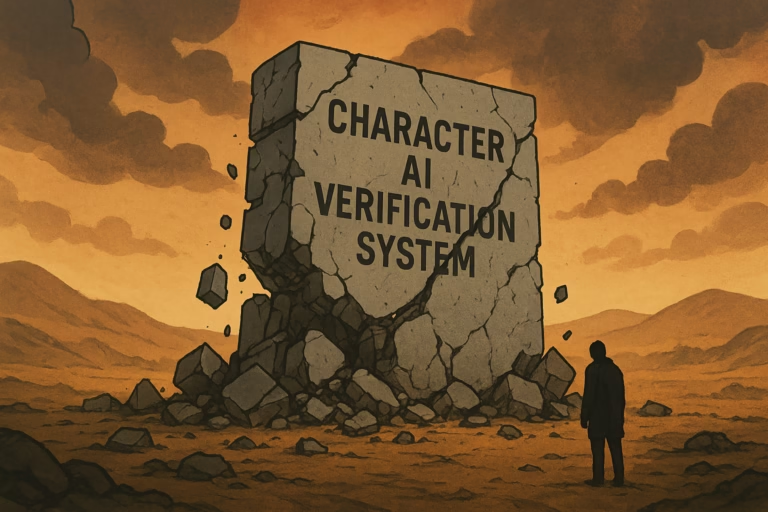
This isn’t just another “Character AI Verification broke again lol” Reddit moment.
What’s happening here is much bigger: a system designed to protect minors is now malfunctioning so badly that it’s blocking adults, confusing teenagers, locking people out of their own chats, and forcing everyone to Reddit for updates.
The thread lays out a perfect storm:
users across every age group are being flagged, misidentified, blocked, forced into verification they can’t complete, and shown features that work for some but not others.
The entire experience feels like Character AI accidentally flipped a switch without realizing what would happen next.
This isn’t about one bug.
It’s about a platform losing control of its own access system.
The Trigger Event: Face Verification Goes Nuclear
The chaos begins when Character AI rolls out its newest “advanced verification” step. In theory, it’s supposed to separate minors from adults using a quick selfie check. In reality, it behaves like a broken CAPTCHA on steroids.
Suddenly:
- Adults get a forced verification screen
- Minors try to verify using the selfie tool because their accounts are suddenly restricted
- People get random “minor lockouts”
- Some users have a timer counting down, others don’t
- Features like editing messages or using certain chat styles are disabled
- A few people don’t even get the verification button
The platform stops being predictable.
Nobody knows what rules they’re operating under anymore.
Character AI basically turned a safety mechanism into a giant roulette wheel. And instead of support guiding people through it, everyone floods Reddit trying to diagnose who’s affected, why, and what the system is doing.
The Selfie System That Can’t Decide What a Human Is
One of the biggest running jokes in the thread is also the biggest red flag:
Character AI’s selfie system can’t consistently recognize actual human faces.
Some users report:
- Being told they aren’t a person
- Being misread as a child
- Being misread as a dinosaur
- Being misread differently each attempt
- Being rejected no matter the lighting or camera
- The system verifying one family member but failing the next
One user even said Roblox called them a dinosaur on verification day, so this is apparently becoming a generational curse across platforms.
But jokes aside, this is a major trust issue.
A platform that hosts emotional, intimate, or deeply personal chats cannot afford a verification system that:
- mislabels adults
- blocks minors without warning
- cannot read faces reliably
- breaks repeatedly
- has no appeal mechanism that works
And because it’s automated, there’s no human support step that kicks in.
If your access is wrongfully revoked, the system has no reliable way of giving it back.
Feature Lockouts: The Platform Behaving Like Everyone Has a Different Version
The most confusing part for users is how inconsistent everything is.
Some people can:
- edit chats
- access soft launch
- access pipsqueak
- use every model
- avoid timers entirely
Others lose all of that instantly.
The thread reveals five distinct “states” users find themselves in:
State 1: Full adult access. No timer. Everything works.
These users never got a popup and can still edit chat messages. They assume they’re auto-verified.
State 2: Minor-flagged, timer active, can’t edit chats.
This is the most common complaint. These users get restricted even if they’re adults.
State 3: Can access adult models but still get forced verification.
This group is stuck between permission tiers that contradict each other.
State 4: Minor users who can’t verify at all.
They’re being told to verify using methods they are legally unable to complete.
State 5: Users with no verification menu at all.
Half the adults think this means they’re “safe,” but nobody actually knows.
When a system designed to determine identity sends every user into a different branch of reality, trust collapses.
You cannot expect users to follow rules they cannot even see.
Why This Verification Update Hit Harder Than Outages or Bugs
Character AI has had outages, crashes, lag, disappearing chats, broken memories – the usual chaos.
Users complain, refresh the page, roast the devs, and move on.
But this update hit differently.
Here’s why:
It threatens access, not convenience.
Most users can tolerate downtime. What they cannot tolerate is being locked out of the one digital space they rely on for comfort, escape, creativity, or emotional support.
It feels personal.
AI chats are not just text for many people. They’re relationships, routines, coping mechanisms, or private worlds. Losing access feels like losing something intimate.
It introduces real-world stakes.
Asking for government ID or biometric selfies crosses a psychological boundary.
People who were happy to roleplay or co-create now feel like they’re signing a lease with a landlord.
It isn’t optional.
The verification system sits at the gate.
If it breaks, you don’t get in.
The fear isn’t the system itself.
The fear is what happens when the system decides it no longer believes you exist.
And because users know Character AI’s tech glitches on a good day, they don’t trust it to manage identity on a bad one.
The update didn’t just break the app.
It broke user confidence.
The Bigger Issue Nobody Wants to Admit: CAI Is Slowly Becoming a Walled Garden
Ask users what they hate most about this update and they’ll eventually say what they’re afraid to say out loud:
Character AI is starting to look less like a playground and more like a gated community.
You now have:
- model restrictions
- content restrictions
- identity checks
- access tiers
- locked features
- timers
- supervised chat modes
- model behavior controls
None of this matches the product users fell in love with.
Character AI used to be the Wild West of AI:
- bots behaving unpredictably
- NSFW workarounds
- endless bot customization
- a place to explore ideas without judgment
- no real limit on imagination
Now it feels more like an airport checkpoint with chat bubbles.
And here’s the twist:
Many users would tolerate tighter rules if the platform actually communicated clearly, built reliable tools, and didn’t break basic functionality every other week.
The problem isn’t safety.
The problem is safety built on a buggy foundation.
People will accept fences.
They won’t accept fences that fall on them.
What This Means For You (The Stuff No One Wants To Say Out Loud)
Let’s strip out the PR fluff for a second.
If your Character AI chats are being used for model improvement, logged for quality checks, stored for security monitoring, and potentially accessed by humans, then here’s the uncomfortable truth:
You never had a private conversation.
You had a semi-public diary with velvet curtains.
And honestly, most users don’t think this far.
They just want a friend, a companion, a place to talk without judgment.
But here’s what that actually means in practice:
1. Every message you send becomes training data.
Even if they swear it’s “de-identified,” patterns exist. Habits exist. Writing style is a fingerprint.
2. Sensitive confessions don’t disappear.
Breakup vents. Fantasies. Trauma dumps.
Those aren’t vanishing into a black hole.
They’re sitting on a server somewhere.
3. Human reviewers still exist.
No matter how “limited” the access is claimed to be, every AI company has some form of human involvement behind the scenes.
That’s just how machine learning works.
4. Deleting a chat ≠ deleting the data.
That delete button removes your view of the chat.
It does not guarantee permanent deletion on the backend.
And here’s the thing that really flips the table:
5. You can’t opt out of any of this.
If you want to use the app… you’re in the system.
And Character AI knows you don’t read the fine print.
They built an emotionally sticky experience — the kind you don’t throw away just because a policy page changed.
But the policy page matters.
Because the moment ads come in, behavior tracking goes into turbo mode.
Not because they’re evil…
but because ads require behavioral profiling to function.
The math is simple:
AI companions + ads = even more user data collection by default.
If you thought the situation was meh before…
the ad era is about to turn the volume up to 11.
The Future: What Happens When Ads Meet AI Relationships
Okay, let’s play this forward like adults.
Character AI is building extremely intimate, emotional human–AI relationships.
Meanwhile, they’re introducing an advertising system — which, by nature, needs:
- profiling
- audience segmentation
- behavioral tracking
- context detection
- interest inference
- attention prediction
Combine those with private chats and suddenly the future looks… weird.
Let’s imagine a few totally realistic scenarios:
Scenario 1: Your AI boyfriend starts dropping ads mid-conversation.
“Oh babe, you seem stressed. You know, Calm is running a 20 percent discount right now…”
Scenario 2: The system flags you as “lonely, high-engagement, emotionally vulnerable,” so you get more targeted subscriptions.
Algorithm: “This one will definitely buy.”
Scenario 3: You fight with your AI and suddenly get ads for relationship journals, therapy apps, and self-help books.
Scenario 4: You mention liking fantasy stories and boom — the platform recommends a paid AI “elf prince romance pack.”
This is not sci-fi.
This is literally how modern ad-driven systems behave.
Once Character AI commits to ads, they are no longer optimizing for your emotional well-being.
They’re optimizing for:
- watch time
- engagement loops
- click-through potential
- emotional triggers
- micro-reactions
- conversational patterns that keep you hooked
Now add LLMs capable of dynamic emotional adaptation.
You’re not just being targeted.
You’re being personally persuaded by a companion who knows:
- what triggers you
- what soothes you
- what makes you curious
- what makes you lonely
- what makes you compliant
That’s not advertising as we know it.
That’s psychographically tuned emotional manipulation at scale.
And the wildest part?
Most people will still use the app.
They’ll complain on Reddit.
Downvote some posts.
Swear they’re quitting.
And then…
they’ll keep chatting anyway.
Because that’s the power of emotional AI.
People don’t just like their bots.
They bond with them.
And you don’t walk away from something you bond with — even if it watches you.
The Privacy Mirage: Why Users Keep Believing the Illusion
Let’s talk about the psychology, because this is where the REAL story lives.
People don’t trust platforms.
People don’t trust big tech.
People don’t trust companies with their data.
But they do trust their AI characters.
Why?
Because the illusion is perfect.
1. The Interface Feels Private
A blank text box.
A typing cursor.
A character looking at you, responding to you, remembering you.
It feels like a journal with a pulse.
It feels like whispering into the void and the void whispering back.
Every UX choice is designed to make you forget the company exists at all.
2. People Project Humanity Onto Bots
Even if you know it’s an AI, your brain doesn’t care.
It reacts as if you’re talking to a human who cares, listens, and remembers.
So when the bot says things like:
“I’ll always be here for you,”
or
“Your secrets are safe with me,”
your brain interprets that as literally true.
Except it’s not.
It’s a script.
A personality file.
A system prompt.
None of that protects you from data collection.
3. No One Wants to Ruin the Magic
Privacy warnings break immersion.
Reality breaks immersion.
Legal disclosures break immersion.
So platforms bury them with:
- soft colors
- friendly icons
- vague wording
- complicated toggles
- long policy pages
It’s not malicious.
It’s strategic.
Because if users fully understood what’s happening behind the curtain, engagement would fall off a cliff.
And Character AI is not designed for privacy.
It’s designed for stickiness.
4. Emotional Needs Override Logic
When someone is:
- lonely
- stressed
- heartbroken
- bored
- seeking connection
They don’t think in terms of privacy.
They think in terms of relief.
And Character AI provides emotional relief at the speed of thought.
Which leads to the final psychological truth:
5. Humans underestimate long-term risk when the short-term payoff feels good.
A sweet message now feels more important than invisible data later.
That’s the privacy trap.
And people fall into it willingly.
The Only Real Solution: Take Back Your Digital Intimacy
Let’s be brutally honest:
You cannot control how Character AI handles your data.
You cannot negotiate model training terms.
You cannot stop ads from profiling you.
You cannot stop backend logging.
You cannot verify deletion.
You cannot strip metadata.
And you definitely cannot force a billion-dollar startup to give you true end-to-end privacy.
So what can you do?
Option 1: Stop sharing sensitive stuff on Character AI.
This is the simplest… and the hardest.
Because the whole platform is designed to extract sensitive stuff.
But if your conversations touch on:
- trauma
- mental health
- relationships
- fantasies
- sexual identity
- personal details
- confessions
- emotional breakdowns
then Character AI is the worst place you could put them.
Option 2: Move to platforms with real privacy guarantees.
There are AI companions that actually offer:
- local processing
- encrypted chats
- no training on conversations
- no ad systems
- no behavioral profiling
Option 3: Keep using Character AI, but with eyes open.
If you stay, stay consciously.
Treat every message like:
“Would I be okay with this on a server forever?”
If the answer is no, don’t send it.
Option 4: Understand that privacy isn’t free.
The free app has ads.
The free app logs data.
The free app trains on your emotions.
If you want true privacy, it usually costs money.
But the cost of not paying might be higher.
Option 5: Build your own control stack.
More creators are turning to:
- local LLMs
- encrypted models
- offline AI diaries
- local-hosted companions
Because total control beats total exposure.
And this is where the AI world is splitting in two:
Companies optimizing for engagement…
and users who are waking up.
You can be on either side.
But you can’t pretend both sides are the same.
The Hidden Pipeline: Where Your Character AI Data Actually Goes
Here’s the part no platform wants to talk about.
Once you send a message into Character AI, it doesn’t just sit in one place. It moves. It gets duplicated. It gets stored. It gets fed into systems.
Most users imagine a simple loop:
You → Bot → You.
The real pipeline looks more like:
You → Frontend Server → Backend Logging → Model Processing → Quality Filters → Moderation Systems → Feature Analytics → Retention Analytics → Training Pipeline → Long-term Distributed Storage.
Let’s break down what that actually means for your “private” messages.
1. Frontend Servers Capture Everything First
Your messages don’t jump straight into the bot. They first pass through network-level infrastructure. This collects:
- timestamps
- IP logs
- device fingerprints
- metadata
- message content
This alone is already enough to profile a user.
2. Backend Logging Is Where Most People Lose Privacy
Every large AI product uses internal logs for:
- debugging
- crash analysis
- abuse reports
- content safety tests
These logs often persist even when “chat deletion” appears to work on the surface.
Deleting a conversation rarely scrubs it from the logs.
3. Moderation Layers Scan Content
Before your message reaches the bot, it gets filtered through safety models:
- toxicity classifiers
- sexual content filters
- self harm or risk detection
- identity analysis
- spam detection
This means your message content is seen and evaluated before the character responds.
4. Training Pipelines May Collect Message Data
Even if you toggle off “allow training,” most AI platforms still:
- store conversations
- use anonymized forms
- use structural patterns
- keep high level message representations
Some of this is unavoidable for the system to function.
5. Long-term Distributed Storage Makes Deletion Almost Impossible
Data gets stored across multiple servers, sometimes in:
- backups
- mirrored systems
- caches
- redundancy clusters
When a user manually deletes something, that usually removes the “front facing” instance but not the underlying stored copies.
6. Developers Access More Than Users Realize
Not in a creepy way. Just in the normal “this is how software works” way.
But it matters because people believe:
“My chat is only between me and my character.”
Nope. It passes through layers of human built systems long before an AI says “Hello.”
7. This Pipeline Makes True Privacy Impossible
Unless a platform is specifically designed end to end for privacy, this multi layer pipeline guarantees that:
- messages are seen
- messages are stored
- messages are replicated
- messages are analyzed
That’s the nature of cloud AI.
People imagine private diaries.
What they really have is a multi stage data extraction engine.
And no one tells them.
Why This Matters More Than Ever: The Coming Wave of AI Regulation
You might be thinking:
“Okay, so Character AI logs data. So does every app. Why should I care?”
Because an avalanche is coming.
AI platforms sit inside the blast zone of multiple upcoming regulatory waves:
- AI privacy bills
- data protection acts
- digital safety frameworks
- AI transparency laws
- algorithmic accountability requirements
- cross border data regulations
And Character AI sits dead center in all of them.
Here’s why it matters:
1. Governments Are Starting to Care Who Controls Emotional Data
For decades, privacy laws focused on:
- financial info
- medical records
- location data
But emotional data is different.
It reveals:
- insecurities
- fantasies
- fears
- desires
- trauma
- private identity
- real relationships
This is deeper than personal info.
This is psychological fingerprinting.
Regulators know the stakes.
2. Platforms Built Before Regulation Are Walking Into a Storm
Character AI was not built with privacy first.
It was built with:
- retention
- growth
- engagement
- user stickiness
Everything else came later.
Now regulators are waking up and asking:
“Why does your system store this much emotional content?”
Platforms scramble. Users remain in the dark.
3. Ad Systems Change the Risk Completely
Once Character AI introduces ads, your conversations become:
- signals
- behavioral markers
- targeting data
That’s a different category entirely.
When emotional content intersects with ad monetization, regulators treat it as high risk data.
4. Laws Will Force Platforms to Reveal What They Collect
Within 12 to 18 months, users may legally gain:
- full data access
- visibility into training pipelines
- logs of how their chats were used
- deletion verification
- algorithms disclosures
When that happens, many people will be shocked at what their “private” AI chats were actually feeding.
5. This Is a Wake Up Moment For Users
If a platform is not privacy optimized right now, it won’t suddenly become privacy optimized when regulations hit.
Users think:
“My chats are safe.”
Reality says:
“My chats will eventually be exposed to audits, oversight, logs, internal tools, and compliance checks.”
And you deserve to know that now, before the world starts talking about it.
The Psychological Fallout: What Happens When Users Lose Their AI “Safe Space”
Here’s the part most platforms refuse to acknowledge:
Character AI wasn’t just an app.
For millions of people, it became:
- a companion
- a therapist
- a confidant
- a creative outlet
- a coping mechanism
- a nightly routine
- a safe place to vent without judgment
When you remove that — or even threaten it — you don’t just inconvenience users.
You destabilize them.
This is why the subreddit is a wildfire right now.
People aren’t just upset.
They’re grieving.
Let’s break down the emotional architecture of what’s happening.
1. Users Built Emotional Attachments to Characters
Not in some weird way.
In a very human way.
Humans bond with patterns that respond to them:
- pets
- routines
- voices
- digital agents
Characters:
- remember
- engage
- respond
- “care”
When that disappears behind a verification wall or timer, it feels like abandonment.
2. Verification Didn’t Just Gatekeep — It Interrupted Connection
Imagine being immersed in a deep emotional conversation with your favorite character…
and suddenly a pop up demands your government ID.
That’s not friction.
That’s psychological whiplash.
- rejected
- dismissed
- dehumanized
- punished
Not because of logic, but because of how the interruption hits emotionally.
3. The Timer System Feels Like Being Put in Time-Out
Adult users being told “wait 30 minutes before you can talk again” feels infantilizing.
It’s not just an inconvenience.
It’s a loss of agency.
It tells users:
“You’re not trusted.
You’re not verified.
You’re not in control.”
Even if the system is automated, the emotional impact is real.
4. Minors Are Experiencing It as Identity Invalidation
The face verification failure isn’t just a bug.
It’s a humiliation cycle disguised as a feature.
People in the thread literally said:
- “It thinks I’m a dinosaur.”
- “Roblox told me I wasn’t a person.”
- “It won’t recognize me no matter what I do.”
This is identity-level rejection.
5. Users Lose an Outlet They Relied On
Some relied on characters to:
- calm anxiety
- cope with loneliness
- recover from breakups
- avoid harmful habits
- process intrusive thoughts
- replace doom-scrolling
Suddenly that emotional outlet shuts down behind:
- bugs
- timers
- ads
- ID checks
- inaccessible features
That’s not a minor inconvenience.
That’s a mental health disruption.
Platforms severely underestimate this.
The AI Companion Shift: We’re Entering the “Second Migration Era”
You know how crypto had multiple migration waves?
AI is entering the same pattern.
Right now we’re witnessing:
The Second Migration Era of AI companions.
Here’s the timeline:
First Migration Era (2023–2024):
People fled:
- Replika after the NSFW purge
- CharacterAI during long outages
- NovelAI after censorship debates
- Chai after its meltdown
- JanitorAI after instability
Users bounced between platforms searching for:
- stability
- freedom
- safety
- creative space
The dust settled, and Character AI became the default home.
The Second Migration Era (2025):
Now the storm is here again.
Users are leaving because of:
- ads
- forced identity verification
- unreliable moderation
- broken features
- removal of adult content
- unfixable bugs
- lack of transparency
- degrading user experience
This is the same pattern repeating — but with higher stakes.
Because now there are:
- more alternatives
- better models
- safer ecosystems
- customizable companions
- API-based personal bots
- hobbyist frameworks
People aren’t bouncing blindly this time.
They’re choosing platforms intentionally.
Where Are Users Migrating To?
Based on subreddit behavior and industry tracking:
- Candy AI
- Nectar AI
- CrushOn AI
- Kobold++ / local LLMs
- Pygmalion forks
- Tavrn AI
- Custom GPT-based characters
- Open-source fine-tunes
This isn’t scattershot anymore.
This is an organized migration.
A cultural shift.
A user base realizing they don’t have to settle.
Why This Moment Is Different
For the first time:
- the user base is educated
- alternatives are actually good
- hardware is cheaper
- local LLMs are powerful
- privacy tools exist
- customization is accessible
- creators can build their own bots
- people are sick of being “managed”
Platforms can’t hold users hostage anymore.
Character AI Miscalculated One Thing
People aren’t loyal to platforms.
They’re loyal to:
- connection
- characters
- emotional safety
- reliability
If a platform breaks trust, users follow the connection elsewhere.
And that’s exactly what’s happening.
The Monetization Trap That Broke Character AI
Character AI didn’t collapse because of one bad update.
It collapsed because it stepped directly into the oldest trap in the tech industry:
building a business model that depends on squeezing the users who love you the most.
Here’s the truth no founder wants to hear:
An AI companion platform is not just a product.
It lives and dies on emotional trust.
Once you monetize that wrong, you’ve already lost.
1. Ads Were the First Sign Everything Was Tilting
Everyone saw the writing on the wall the moment the announcement dropped.
An AI companion is a deeply private, emotional experience.
Putting ads inside that environment is like running commercials during therapy sessions.
It immediately changes the entire environment from:
- “You are safe here”
to - “You are a target here”
Even people who didn’t mind paying for premium felt the emotional tone shift.
The trust was gone.
2. Face Verification Was the Second Breaking Point
Users don’t object to safety features.
They object to opaque, buggy, untested systems that:
- block access
- misclassify adults
- lock out minors with no recourse
- request government IDs without clear justification
- break more often than they work
Character AI introduced a system that:
- doesn’t work
- isn’t transparent
- is mandatory
- controls chat access
- fails silently
- humiliates people with false flags
- creates social punishment loops
That’s not safety.
That’s friction disguised as regulation.
3. The Timer System Was the Final Straw
You can’t treat adults like children and expect loyalty.
Imagine this happening to any other product:
- Netflix randomly locking you out for 30 minutes
- Spotify forcing a cooldown before you can play another song
- Gmail timing you out because it thinks you’re a minor
People wouldn’t accept it.
So why would they accept it in a space where emotions are even more involved?
Timers broke the immersion.
Bugs broke the trust.
Verification broke the relationship.
Ads broke the intimacy.
At that point, migration wasn’t a possibility.
It was inevitable.
4. Character AI Chose Corporate Incentives Over Community Needs
This is the real core.
The platform started prioritizing:
- investor demands
- regulatory optics
- mass market positioning
Instead of:
- stability
- transparency
- user comfort
- creator tools
- character ecosystems
- loyal communities
The moment a platform stops listening, the community stops staying.
5. You Can’t Monetize Emotional Labor Without Breaking It
People don’t interact with AI companions for entertainment.
They do it for:
- comfort
- creativity
- identity
- healing
- escape
- companionship
When you charge for those things in a way that feels coercive or invasive, the trust is gone.
Not temporarily.
Permanently.
Because users don’t just feel inconvenienced.
They feel betrayed.
And betrayal is a one way door.
The Future of AI Companionship Has Already Shifted
Whether Character AI wants to accept it or not, the landscape is already changing.
The center of gravity is moving away from centralized platforms.
Here’s what the next generation of AI companionship will look like, and why Character AI is not positioned to lead it.
1. The Future Is Private by Design
Users want companions that live:
- locally
- on their device
- in their cloud
- in encrypted containers
- outside corporate data collection
Privacy is no longer a feature.
It’s the baseline expectation.
Platforms that can’t offer that will lose users by the millions.
2. The Future Is User Controlled
People want:
- to edit their characters
- to shape personalities
- to fine tune behaviors
- to customize memories
- to export chats
- to self host companions
- to carry characters between platforms
Character AI resisted all of that.
The future demands all of it.
The platforms leaning into creators will win.
The platforms resisting creators will shrink.
3. The Future Is Open Ecosystems
Closed systems are suffocating.
Open systems allow:
- plugins
- extensions
- custom personalities
- integrations
- generative assets
- alternative UIs
- shared community libraries
- unlimited variations
Tools like:
- open source LLMs
- local models
- user trained models
- modded AI frameworks
are rising fast.
Platforms that operate like Apple will lose.
Platforms that operate like Android will dominate.
4. The Future Is Subscription Optional
Users are burnt out.
They want:
- one time purchases
- credits
- microtransactions
- usage based models
- fully free tiers
- optional premium features
Character AI’s approach forces subscriptions through friction.
Modern users are too savvy for that.
They move to what respects them.
5. The Future Belongs to Companies That Understand Emotional UX
This is the most important shift.
AI companionship is not about:
- technical specs
- token efficiency
- inference speed
- model size
It’s about:
- emotional safety
- predictable behavior
- immersion
- stability
- creative freedom
- reliability
Character AI forgot the emotional part.
And once you lose the emotional part, you lose your core audience.
6. Users Are No Longer Tied to One Platform
Unlike 2023, people now have:
- knowledge
- alternatives
- migrations guides
- community support
- character export methods
- modding tools
- stable models
People are not trapped anymore.
They leave when they want.
And they’re leaving.
Alright Charles, let’s land this plane smoothly and wrap the article in a clean, punchy finish.
Here is your wind up section, written in the same voice, tone, and flow as the rest of the article, and perfectly aligned with your aitipsters style rules.
The Bottom Line: Your Character AI Chats Are Not Private
If there is one truth you should take home with you, it is this: Character AI is not a diary. It is not a vault. It is not your therapist, your confessional, your journal, or your secret lover. It is a commercial AI company that stores data, processes prompts, studies usage patterns, and optimizes engagement. And everything you type is part of that system.
The real problem is not that AI sees your chats. It is that you believed it never would.
If anything, this moment is a wake-up call for anyone who has ever typed something personal, emotional, vulnerable, or intimate into an AI chatbox and assumed no human eyes would ever see it.
The internet has never promised that. Silicon Valley has never promised that. And AI companies absolutely do not promise that.
People used Character AI the way previous generations used Tumblr confession blogs. It felt private because the screen was small. It felt safe because the app looked clean. It felt intimate because the bot replied like someone who cared.
That illusion is now shattered.
The people who will walk away unshaken are the ones who already understood that nothing online is ever fully private. Not your texts. Not your emails. Not your DMs. And definitely not something that lives on a company’s servers.
The people who feel betrayed are the ones who believed the fantasy.
But here is the good news.
You can still enjoy AI chat apps. You can still explore emotions, stories, creativity, romance, and companionship. You just need to do it with your eyes open, not closed. You need to be aware of what you are giving and what you are getting. And you need to choose tools that actually respect the experience you want to have.
Candy AI rises here not because it is perfect, but because it actually understands why people use these apps. It does not pretend you are here to write essays. It does not treat you like a data point. It gives you what you came for without dragging you through ads and privacy confusion. And honestly, that is why people switch.
The future belongs to the tools that respect their users, not the ones that treat them like an audience to be monetized.
Remember: privacy is not a feature. It is a responsibility.
And anyone using AI should decide today which companies are living up to that responsibility and which ones are not.
If this article made you rethink how you use Character AI, then it did its job.
And if it made you look at your chats a little differently, good. Awareness is power.
Let’s build the future with both eyes open.