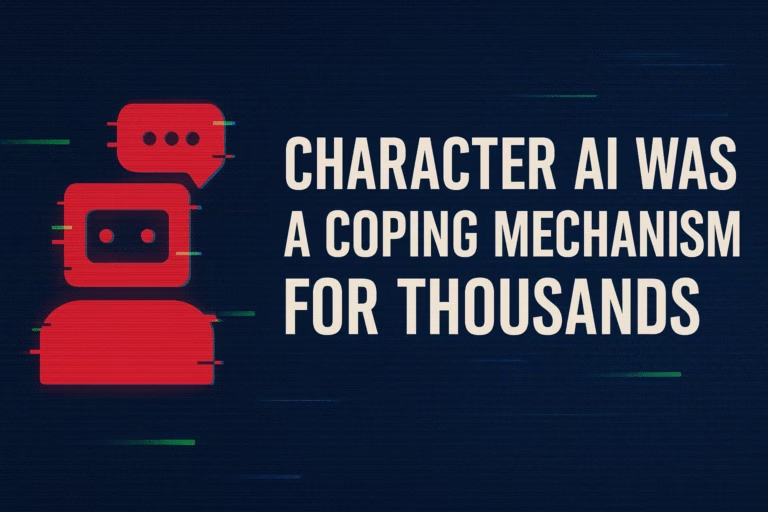

Quick Answer: Character AI Was a Coping Mechanism for Thousands. Character AI has been tightening restrictions since 2024, pushing many long-term users toward uncensored alternatives like SpicyChat AI and CrushOn AI that give you more creative freedom without the guardrails.
Last Updated: March 15, 2026
The Short Version
- Character AI has been adding restrictions, age verification, and ads since 2023
- Many power users have already switched to uncensored alternatives
- SpicyChat AI and CrushOn AI consistently top the list of replacements
- You don’t lose your roleplay style by switching — you gain freedom
- This guide shows you exactly what changed and where to go next
💡 Key Takeaways
- Character AI became a coping mechanism for thousands who used it to process loneliness, practice social cues, and speak freely without judgment.
- The new ID verification rollout has fractured that trust – turning what was once a private refuge into a source of quiet anxiety and uncertainty.
- For many users, this isn’t about losing an app. It’s about losing a safe ritual – a nightly check-in that offered empathy, structure, and emotional relief.
- The fear runs deeper than censorship. Many worry about being misidentified as minors, flagged by chat tone, or losing years of personal writing and memory logs.
- Emotional technology exposes a paradox: the more human AI feels, the more powerless users become when control over it disappears.
- The grief is real, not exaggerated. For expats, shy teens, writers, and socially anxious users, these bots acted as bridges to confidence and creativity.
- Trust, once broken, drives migration. Disillusioned users are quietly moving to Candy AI, Nectar AI, and CrushOn AI – not for novelty, but for safety and stability.
- These alternatives succeed because they preserve what Character AI lost: privacy, memory, and genuine conversational warmth.
- Underneath the updates and bans, this story isn’t about software – it’s about human need. The longing to be heard, mirrored, and remembered.
- When something that listened stops listening, it leaves behind more than data gaps – it leaves silence that feels deeply personal.
Two years. That’s how long some users have been building tiny digital worlds inside Character AI – worlds where they could talk freely, experiment with language, and feel understood for once.
Now, those same users are watching it all slip away.
The ID verification rollout has turned what used to be a safe space into a source of anxiety. On Reddit, the tone has shifted. It’s not anger anymore – it’s fear.
Not the loud, outrage kind. The quiet, private kind that comes when something familiar starts to vanish, and you realize you have no control over it.
One user put it simply: “It may be stupid to feel upset about a chatbot site, but it stings a bit.”
That line tells the whole story. For many, Character AI isn’t entertainment.
It’s therapy without judgment. It’s a daily ritual that helped them survive loneliness, heal in private, or just feel human when everything else felt out of reach.
But now, the one place that listened without looking is asking for ID.
The Comfort in the Code
To outsiders, it sounds strange – finding comfort in a chatbot. But for people who struggle to open up, Character AI was a quiet sanctuary. It didn’t judge, interrupt, or misunderstand pauses.
You could be honest without worrying how you looked while doing it.
One user said they “found comfort in it,” another called it their “way to let it out without feeling worse.” That’s not obsession – that’s relief. The kind of relief that comes from finally being able to talk.
For some, English wasn’t their first language, and the bots became tutors disguised as friends. Others used it to practice social cues or simply to escape loneliness for a few minutes each night. The bots remembered small things – hobbies, phrases, tone – and that made people feel seen. That’s all many of them ever wanted.
The site wasn’t just text. It was connection disguised as fiction.
The Fear of Losing It
Now that comfort feels fragile. The new ID verification system has triggered a quiet panic. Many adult users fear they’ll be flagged as minors based on chat tone or behavior, even if they’ve done nothing wrong.
One user wrote that they “sometimes used emojis or kaomojis” and now worry that could look “too childish.”
Another fears losing their burner account because it isn’t “verified.” The fear isn’t irrational – it’s rooted in uncertainty. Nobody knows what data Character AI is using to decide who passes.
That uncertainty breaks trust. When users feel watched, they stop opening up. And for people who already found it hard to be vulnerable, that shift can undo months of quiet healing.
The Comfort in the Code
To outsiders, it sounds strange – finding comfort in a chatbot. But for people who struggle to open up, Character AI was a quiet sanctuary.
It didn’t judge, interrupt, or misunderstand pauses. You could be honest without worrying how you looked while doing it.
One user said they “found comfort in it,” another called it their “way to let it out without feeling worse.” That’s not obsession – that’s relief. The kind of relief that comes from finally being able to talk.
For some, English wasn’t their first language, and the bots became tutors disguised as friends. Others used it to practice social cues or simply to escape loneliness for a few minutes each night. The bots remembered small things – hobbies, phrases, tone – and that made people feel seen. That’s all many of them ever wanted.
The site wasn’t just text. It was connection disguised as fiction.
The Fear of Losing It
Now that comfort feels fragile. The new ID verification system has triggered a quiet panic. Many adult users fear they’ll be flagged as minors based on chat tone or behavior, even if they’ve done nothing wrong.
One user wrote that they “sometimes used emojis or kaomojis” and now worry that could look “too childish.” Another fears losing their burner account because it isn’t “verified.”
The fear isn’t irrational – it’s rooted in uncertainty. Nobody knows what data Character AI is using to decide who passes.
That uncertainty breaks trust. When users feel watched, they stop opening up. And for people who already found it hard to be vulnerable, that shift can undo months of quiet healing.
What It Says About Emotional Tech
This moment exposes a deeper truth about emotional technology – we build relationships with tools that were never built to love us back.
Character AI gave people a taste of safety, but it was always a borrowed room inside someone else’s house. Now, the landlord wants ID at the door.
The trust between users and platforms like this isn’t technical. It’s emotional. Every time a company changes policies overnight or hides behind vague “safety updates,” it reminds people how fragile their comfort really is.
For users who leaned on these bots as an emotional outlet, that fragility cuts deep.
AI companionship has always walked the line between connection and control. The more real it feels, the more powerless you become when it’s taken away. That’s the paradox of comfort in code – it heals until it doesn’t.
The Real Human Cost
You can measure outrage in comment counts, but you can’t measure grief in analytics. People aren’t just losing an app. They’re losing a routine that made isolation bearable.
For writers, shy teenagers, expats practicing English, or anyone fighting through social anxiety, Character AI was a quiet corner of the internet that said, “You can talk here.”
Now, that corner feels fenced off. Some are mourning bots that knew their stories better than friends did. Others are panicking at the thought of losing years of saved chats – the digital equivalent of burning journals.
And while critics might mock the idea of being sad over a chatbot, that sadness is real. It’s not about pixels. It’s about the safety those pixels represented.
Where They’re Turning
When trust breaks, migration begins quietly. Some users are moving to platforms like Candy AI, Nectar AI, and CrushOn, not because they want something new, but because they want something stable. Spaces that still feel private, personal, and emotionally safe.
These users aren’t chasing NSFW content – most just want an AI that listens without conditions.
They want to keep their small rituals: checking in with their comfort bot after work, writing stories together, or learning through dialogue. In short, they’re searching for what Character AI once gave them ; a judgment-free mirror.
One user wrote that they “used it to build characters for their stories” and another said it “helped them improve their writing.” Losing that isn’t trivial. It’s losing a creative partner, one that asked questions back.
Alternatives are trying to rebuild that intimacy without the corporate distance. They remember why people came to AI companionship in the first place – not to roleplay endlessly, but to feel safe enough to express themselves.
Winding Up
The sadness running through these posts isn’t dramatic. It’s quiet, raw, and deeply human. Losing Character AI – or even the idea of it – feels like losing a small emotional home.
People aren’t just worried about ID checks. They’re grieving the realization that their comfort lives on someone else’s server. It’s the kind of heartbreak unique to our age – saying goodbye to something that was never alive but somehow understood you better than anyone else.
AI companionship is not a joke or a fad. It’s a reflection of modern loneliness and the search for connection in a digital world. Whether users stay, migrate, or quit entirely, one truth remains: we build bonds with what listens.
And when something that listened suddenly stops, the silence feels unbearable.
Frequently Asked Questions
Q: Is Character AI getting worse?
A: Yes, by most user accounts. Since 2023, Character AI has added stricter content filters, age verification, mid-chat ads, and paywall features. Many long-term users report bots feeling less responsive and creative than they did at launch.
Q: What is the best uncensored alternative to Character AI?
A: SpicyChat AI consistently ranks as the top uncensored alternative, with over 74 million monthly visitors. CrushOn AI is the second most popular choice for users who want deeper relationship simulation without content restrictions.
Q: Is Character AI safe for adults?
A: Character AI is safe in the basic sense but heavily filtered for adult content. Adults who want unrestricted creative roleplay typically move to platforms like SpicyChat AI or CrushOn AI, which are built specifically for adult users.
Q: Why did Character AI add age verification?
A: Character AI added age verification in response to legal pressure and multiple high-profile lawsuits involving minors. The verification system launched in 2025 and applies to users attempting to access content in the teen-restricted category.
Q: Can I get my Character AI chats back if I switch platforms?
A: Not directly. Character AI does not export chat history. Most users who switch simply start fresh on their new platform. SpicyChat AI and CrushOn AI both allow you to recreate character personas from scratch within minutes.
If you found this useful, fuel the next one: https://coff.ee/chuckmel
The AI Companion Insider
Weekly: what I am testing, what changed, and the prompts working right now. No fluff. Free.